
A mini-series exploring the state of the game in the Great Lax State. In this part, assessing the quality of high school talent.
As a relative neophyte to the game of lacrosse, and particularly the overall scene in Michigan, I was surprised to find that, despite the growth of the game nationally (and in the state of Michigan as well), the quality of play, at least at the high school level, is considered to be in a down phase. Is it the talent? Here’s the number of high schoolers going on to NCAA ball over the past five years (the full extent of LaxPower’s data):
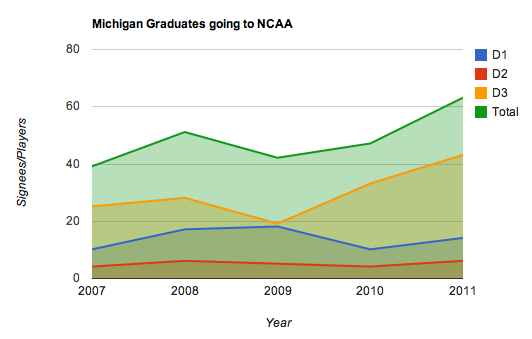
Graduates Playing NCAA Lacrosse by Year
Contrary to the perception, it actually seems that the quality of high school talent bottomed out in 2009, but is on the rise ever since. It’s possible that the perception is misguided. Why might that be the case?
- A couple traditional powers have struggled, including East Grand Rapids and Detroit Country Day (though the Yellow Jackets said “I’ll show you struggles” all the way to the State Championship – in which they played EGR – so take it for what it’s worth).
- Style of play. This relates to the previous point, as Country Day played a slow-down brand of lacrosse this season, which isn’t exciting, and can lead some to believe that there’s a lack of skill in the state.
- The Brother Rice effect. Far-removed from their 2008 national championship, the Warriors have struggled against out-of-state teams – dropping games to squads from Ohio (twice), Illinois and Ontario in 2011 alone – but still dominated in the mitten. This leads many to believe that Rice is not as strong as they have been, and thus the in-state teams that they’re beating aren’t strong either.
Of course, there’s a good chance that there’s at the very least a kernel of truth to the idea that high school talent has slipped. For one thing, the number of spots on college teams has not remained static. Division-1 teams have increased from 56 to 61 in the years listed in our sample above. D-2 programs have gone from 33 t0 42, and D-3 programs increased from 138 to 179. With total opportunities increasing from 227 schools to 282 (about 25%), we would assume that, all else being equal, Michigan players would increase at the same rate.
Michigan players continuing their play at the NCAA level have increased by 61%, so either there are other factors at work, or our original premise – that the quality of play in the state is down – is incorrect. So, how about some other factors?
- Increase in college opportunities in the state. In-state colleges are more likely to recruit players from Michigan, meaning there’s a rise at greater-than-expected pace, compared to the percentage increase in programs overall.
- Increase in high schools playing. With the same number of players at a greater number of schools, the talent pool is diluted. Guys who wouldn’t have made a team when there were, say, 20-some programs in the state have the chance now that there are more than 90.
My guess is that these two factors guide the perception of the talent in Michigan being “down” compared to what the numbers say. It’s not that there are fewer talented players, it’s that they make up a smaller piece of the pie – which in turn helps make the best teams less-prepared when they play out of state competition. On the other side of the coin (and I’ll talk about this more in Part 2), that’s good for the long-term quality of play in the state, even if it makes for some frustrating times now.
I’m interested to hear from some readers who have been following the high school game in Michigan much longer than I have. Is the talent in Michigan truly down? Is it just more spread out? What are some reasons for the perception, or is it simply a true statement?
Pingback: State of the State Part 2: Game Overgrown? | Great Lax State
Pingback: Linkage Double Dose | Great Lax State
Pingback: State of the State Part 3: The System is Holding Me Down, Man | Great Lax State
Pingback: State of the State Part 4: The Future | Great Lax State
Pingback: Lax Links 11-11-11 | Great Lax State