I’ve heard varying opinions on whether Michigan rising sophomore Emil Weiss is capable of backstopping a top NCAA team. A few people have said they don’t think he has the skill level required, but the numbers – to me, at least – indicate that he’s not only adequate, but in fact exceptional.
Porous D
The first thing that must be taken into account when breaking down Weiss’s numbers is the defense that played in front of him. With all due respect to Michigan’s Team One, that defense… it was not so good. The Wolverines’ D landed 55th in tempo-free rankings, allowing .361 goals per possession to opposing offenses (adjusted for schedule strength).
It’s totally feasible (in fact likely) that Weiss is at least in part to blame for that, but my suspicion is that he bailed out the defense at least as much as he spoiled a valiant effort on their end. Anecdotal evidence and “feel,” while nice to confirm our suspicions, don’t tell us the story.
Weiss v. the Field
Emil Weiss was not exactly America’s healthiest goalie in 2012. He missed four games due to injury, and was limited throughout portions of others. When he wasn’t between the pipes, things got very ugly:
| Goalie | Sv% | GAA | Mins. |
|---|---|---|---|
| Emil Weiss | .519 | 11.80 | 580 |
| Others | .343 | 15.86 | 261 |
| Total | .465 | 13.06 | 841 |
It’s clear that Weiss was head-and-shoulders above Michigan’s other options, even if his numbers still weren’t stellar.
But Were They Stellar?
You’re not going to find the goalie of a 1-13 team with stellar stats. But what if I told you that the goalie of the country’s third-worst team (and sixth-worst defense) actually had a save percentage in the top half of the country’s keepers? In such a crazy instance, obviously it’s the goalie keeping his team afloat – and his defense not doing him any favors – more than anything.
Such was the case for Weiss in 2012. Although Michigan had the No. 55 tempo-free defense, Weiss’ .519 save percentage was No. 30 nationally, just behind Johns Hopkins goalie Pierce Bassett (part of the country’s No. 4 tempo-free defense, though the stats indicate that he was more a hindrance than an integral factor in that team success).
Even with Weiss’ defense not doing him any favors, he was still highly-ranked in the most important goalkeeping statistic. What if he had been playing with that Hopkins D in front of him? Surely, fewer easy looks would have resulted, and his numbers would have been even better.
Quick side note – his numbers are slightly worse than they should be, as well. Although it appears to be proper record-keeping to credit Weiss with a goal against when an opponent scores on an empty net against the 10-man ride, that’s obviously not his fault. I can think of at least two such instances this past season.
Not Getting the Help
Generally speaking, it’s a goalie’s job to stop any shot by the opposition, but team defense is obviously much more complicated than that. The defensive scheme is designed to make things easier (or at least possible) for the keeper by preventing opposing offenses from getting easy looks. Though breaking down what constitutes an “easy look” is nearly impossible without seeing every single game, assist rate is one way to tell.
It’s much more difficult for a goalie to stop an assisted shot, simply because the ball is moving quickly enough that the shot is not coming from where he expected, and his reactions must be quicker. Since it’s not his duty to prevent assisted looks from being taken, the goalie is relying on his defense to help him out in that instance.
Michigan opponents assisted on .721 of their goals (nearly three quarters), and that’s good for third-most in the country – behind a pretty good Bucknell defense and a pretty bad Quinnipiac defense*. That means goals scored on Weiss were generally of the type he didn’t have as much a chance to stop.
Going Forward
So, it’s established by this point that Weiss is at the very least, a well-above average goalie. What does it say for the future?
For one thing, the base expectation is that Michigan’s defensive field players will be better in 2013 than they were in 2012. There are multiple reasons for this (most of which fall under the category “duh”). The players from last year’s D will have another year experience, there will be more players available who were recruited by the Division-1 version of Michigan, and there will be more players and more depth overall.
The better defense in front of the goalie should lead to an even better year. Incoming freshman Gerald Logan is also a pretty talented keeper himself. His presence on the roster will increase the competition in practice, and could result in either taking the job for himself, or at the very least forcing Weiss to continue stepping up.
However it plays out, goalie should be a strong point of Michigan’s next few editions of varsity lacrosse (and on into the future, with a verbal commitment in each class through 2015).
* Defense assist rate in itself does not indicate quality of a team’s defense. In fact the correlation between the two is practically zero:
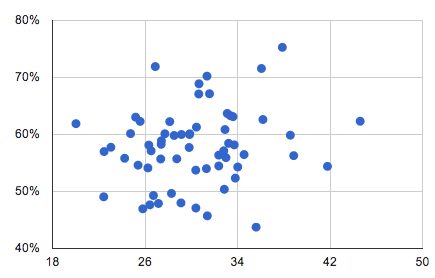
Assist rates on the Y-axis, Defensive efficiency on X.
It’s more an indication of style: some defenses are designed to prevent the opponent from setting up dodgers, some are set up to shut off the crease, some run a zone to force the opponents to shoot from outside. It’s possible to be good while running any of those styles. What assist rate indicates in this specific example is how much the defense is protecting their goalie (in Michigan’s case, not much).
9 Responses to Michigan Improvement ’13: Is Emil Weiss an elite goalie?