What is blog? (Baby don’t hurt me). Slowly getting around to some of the usual offseason posts, trying to get caught up… eventually.
Michigan took strides once again between the 2013 and 2014 seasons. They climbed from the TFL-ranked No. 61 (of 63) the previous spring, up to No. 48 (of 67). They made major gains in some respects, stagnated in others, and without a nice finish to the season, might have even taken a step back in one or two areas.
It’s still a young program, and last year’s squad in particular was hit by a greater-than-average injury bug. If you told me a team was going to lose its top goalie and a starting defender before the year, I’ expect that side of the ball to struggle. U-M turned it on later in the season to bring some respectability.
Let’s take a quick look at the Wolverines’ statistical profile:
| Michigan Wolverines 2014 | |||
|---|---|---|---|
| Michigan | Opponents | ||
| Faceoff Wins | 202 | Faceoff Wins | 209 |
| Clearing | 276-311 | Clearing | 260-309 |
| Possessions | 562 | Possessions | 553 |
| Goals | 157 | Goals | 201 |
| Offensive Efficiency | .279 .293 adj |
Offensive Efficiency | .363 .358 adj |
Michigan managed to possess the ball more than opponents for the first time in program history, and that played a big part in the team’s improvement from 1-13 to 5-11. They also improved offensively, and held their own at times defensively.
What Went Well
Sophomore midfielder Kyle Jackson became Michigan’s first All-ECAC first-team selection, and played a big role in the team’s leap forward on offense. He was relied upon less to do everything for U-M, and was more comfortable as a key player, not the key player on O. He was helped there by a fellow goal-stuffer in freshman attack Ian King. King was strictly a finisher for Michigan this year (32 goals, one assist), but led the team in scoring and should have a more diverse role in due time.
Faceoffs have been an adventure at times for Michigan, and nearing the .500 mark is a definite sign of improvement. Brad Lott was more consistent (though the occasional 4/15 or 7/20 game needs to be hammered out), and the wing play improved, despite Michigan’s injuries among wing players.
Defensively, Michigan took a big hit by losing Gerald Logan to shoulder surgery before the season (and starting pole Charlie Keady to injury, and several players on defense for a few games here and there), but managed to get things together by the end of the season. Freshman netminder Robbie Zonino improved greatly over the course of the season, and the unit was solid by the end of the year. There are strides yet to go, but U-M is on track.
The injury bug emphasized Michigan’s adaptability over the year. Sure, you’d like to see the Maize and Blue go with their top players at each position wire-to-wire, but that’s not going to happen. In a season where that was never the case, they tinkered with lineups and prepared understudies to get on the field. Further adapting with position changes (for example Brendan Gaughan moving from attack to midfield, and rounding into a useful player at his new position by the end of the year) staved off any form of complacency – as much as a sub-.500 team can grow complacent – and showed that the future is bright when all the pieces are in place.
Room for Improvement
Just about everything can improve for Michigan, including the record (and the tempo-free ranking, which was still in the bottom third nationally). Taking steps in the right direction is not the same as arriving at the destination.
U-M playing fully healthy is out of the question, but playing with fewer of its top-line options out, including Logan and Keady – needs to happen to reach the goals of this team. There’s no strength and conditioning program that can totally avoid injury, but developing further depth so that, at the very least, the dropoff is less severe, will be a key.
I alluded to this above, but Michigan’s improvement on faceoffs came with some real clunkers from time to time. Continuing to approach consistency with Lott and other specialists – while working with wings to win a greater percentage of the 50/50 balls – will help keep games within reach.
Speaking of those 50/50 balls, Michigan still lost the GB battle on the year (471-490), and that’s something where talent will help improve things.
It’s tough to harp on Michigan’s defense given the personnel losses, but it was… still not good. Robbie Zonino’s improvement over the course of the year was notable (see chart), but never got his cumulative save percentage up to .500. Gerald Logan finished the previous year at .563 on a worse defense. Both the outfield players and the goalie have room for improvement. Playing the “statistical manipulation that doesn’t work” game, if Zonino had saved as great a percentage of shots faced as Logan the previous year, U-M would have allowed eight fewer goals on the year.
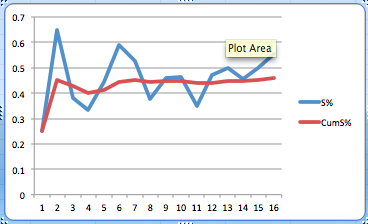
Robbie Zonino Save Percentage, game-to-game in blue and cumulative in red.
The Distant Future
Michigan’s talent influx continues: the Wolverines signed a top-20 recruit in goalie Tommy Heidt, and added another top-100 player in longpole Hugh Mosko. Add in several players returning from injury, and the addition of UMass transfer Aaron Madaisky, and the depth situation on defense won’t be as dire this year. The Maize and Blue have a chance – and a good one – to turn that into production.
Michigan’s club holdovers have given a lot to the program, and probably performed above the level expected of them. That said, with a few exceptions, most of them are probably wouldn’t be playing with the types of recruiting classes Michigan is bringing in. The talent influx is the theme of this program, and probably has two more years (Michigan’s “first recruiting class,” the 2012 freshman group, was not compiled with the promise of playing at the D-1 level secured) before the idea of what this program will be manifests itself.
That said, Michigan’s young Division-1 recruits are adding experience. Whether it’s the first class – who will be seniors in the fall – or the first full D-1 class, there’s finally an upperclassman on this roster recruited to play at this level. The coaches implementing training and gameplans to prepare those players to reach their potential is just as big.
That’s one area where I think the loss of offensive coordinator Ryan Danehy will hurt. From all appearances – statistically, eyeball test, and otherwise – he was the real deal. From improving players’ fundamentals to getting a plan together to win games (or at least come as close as talent and execution would let things get), he’s a loss. How much new OC Conor Ford will be able to fill that gap is as-yet an unknown – one that I’ll be exploring more in the future. It’s possible that he outperforms even the high bar Danehy set. It’s also possible that he can’t live up to it.
With players like Lott entering their upperclassman years, the consistency should start to hammer out. He was up-and-down (with too much down) as a freshman, balanced things out between the two extremes as a sophomore, and should be able to be more consistently positive as a junior.
All told, Michigan took a step forward in quality (if not win percentage) from year one to year two. The following offseason saw a bigger leap, including on the final record. Year four should see Michigan start to become what its long-term future is.
6 Responses to Requiem for a Season: Michigan Wolverines 2014